Road traffic safety refers to the methods and measures used to prevent road users from being killed or seriously injured. Typical road users include pedestrians, cyclists, motorists, vehicle passengers, horse riders, and passengers of on-road public transport (mainly buses and tricycles in Adamawa state).
Road traffic crashes are one of the world’s largest public health and injury prevention problems. The problem is all the more acute because the victims are overwhelmingly healthy before their crashes. According to the World Health Organization (WHO), more than 1 million people are killed on the world’s roads each year.A report published by the WHO in 2004 estimated that some 1.2 million people were killed and 50 million injured in traffic collisions on the roads around the world each yearand was the leading cause of death among children 10–19 years of age. The report also noted that the problem was most severe in developing countries and that simple prevention measures could halve the number of deaths.
road traffic safety purposes it can be helpful to classify roads into three usages: built-up urban streets with slower speeds, greater densities, and more diversity among road users; non built-up rural roads with higher speeds; and major highways (motorways/ Interstates/ freeways etc.) reserved for motor-vehicles, and which are often designed to minimize and attenuate crashes. Most injuries occur on urban streets but most fatalities on rural roads, while motorways are the safest in relation to distance traveled.
Best-practices in modern road safety strategy:
The basic strategy of a Safe System approach is to ensure that in the event of a crash, the impact energies remain below the threshold likely to produce either death or serious injury. This threshold will vary from crash scenario to crash scenario, depending upon the level of protection offered to the road users involved. For example, the chances of survival for an unprotected pedestrian hit by a vehicle diminish rapidly at speeds greater than 30 km/h, whereas for a properly restrained motor vehicle occupant the critical impact speed is 50 km/h (for side impact crashes) and 70 km/h (for head-on crashes).
As sustainable solutions for all classes of road safety have not been identified, particularly low-traffic rural and remote roads, a hierarchy of control should be applied, similar to classifications used to improve occupational safety and health. At the highest level is sustainable prevention of serious injury and death crashes, with sustainable requiring all key result areas to be considered. At the second level is real-time risk reduction, which involves providing users at severe risk with a specific warning to enable them to take mitigating action. The third level is about reducing the crash risk which involves applying the road-design standards and guidelines, improving driver behavior and enforcement.
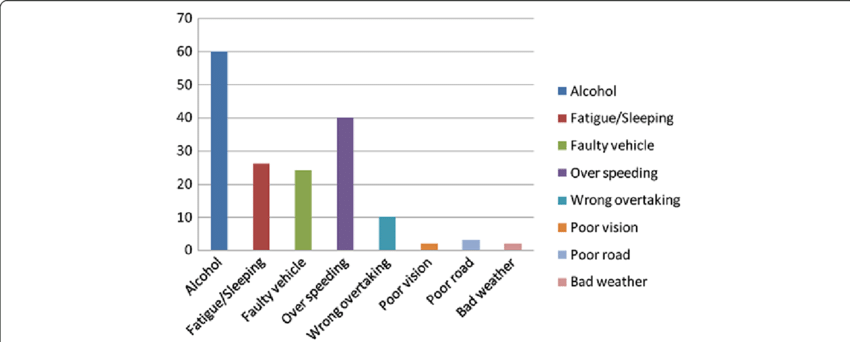
Looking at the causes of road accident in Adamawa state, the major contribution factors is alcohol, drugs abuse, over speeding, inadequate knowledge on roads sign and improper orientation to road users by the major roads commission agencies and other transport organizations in Adamawa state.
Behaviours of Roads Users in Adamawa State. (Causes and Control Measures)
Distracted Driving
Probably the number one cause of serious accidents is distracted driving. When a driver is fully alert and paying attention to the road, they might still get in an accident, but it is often less severe because they have more time to react. Talking or texting on a cell phone is a frequent cause of distracted driving but anything that diverts your attention from the road can lead to an accident.
If you can’t resist the buzzing of your cell phone, turn it off or set it to do not disturb while you are driving – better yet, keep it out of sight. A text or call may seem important, but it is never worth risking serious injury or worse.
Shooting Gaps
Some drivers in Adamawa state, when they feel that traffic is not moving quickly enough for them, may feel tempted to speed things by darting into traffic when they are merging, changing lanes or making a left turn. This is referred to as shooting gaps.
The problem is, it doesn’t give other drivers enough time to react and it can result in a crash. The best way to avoid this is to remember your old driver’s education course, merge and make left turns properly.
Going too fast
When an accident happens because of speeding, it is usually much worse than it would have been if everyone was following the speed limit. But accidents involving too much speed don’t always happen because someone broke the speed limit. Driving too fast for weather conditions can also lead to accidents.
Remember, even if you’re in a hurry, it won’t matter if you’re in an accident. Obey posted speed limits and slow down even more when the conditions require it.
Following too closely
One of the most common causes of rear-end collisions is following too closely behind another vehicle. If the car in front of you comes to a sudden stop, you need to make sure that you have room to safely stop as well.
The faster that traffic is moving, the more room you will need to stop.









 Toshiba Studio